ORIGIN
It all started with a law firm.
About forty people, partners who use AI every day, and an AI budget that wasn’t earning its keep. Appliance was born from that conversation.

Six months waiting on Copilot licenses
We met the firm’s managing partner at the INIT-IA-TIVE breakfast conference at the Hub des Alpes. For him, whether to adopt AI was no longer the question: the partners use it every day and push their teams to do the same.
For more than six months, he had been asking his IT provider for Microsoft Copilot licenses. The same provider that set up his computers, network and printers, the one he called the moment something stopped working. On AI, though, nothing was moving.
In the meantime, other offers had reached him: the specialized legal AIs, Legora and Harvey, billed at €700 to €1,000 per seat per month. For the firm, that came to €28,000 to €40,000 a month. Too expensive. And the firm had already learned the hard way: its seven Doctrine licenses, locked in for three years at €24,000 a year, are used by only two or three people.
So he bought 40 Gemini licenses, at €200 per seat per month: €8,000 a month, or €96,000 a year. Not because it was the right tool, but because staying on the sidelines seemed costlier still.

Caught between two risks
Legora, Harvey and Doctrine are built for regulated professions and commit to the confidentiality those professions require. Gemini is a general-purpose tool that offers no such guarantees. The contracts and client files his team puts into it go to American servers, under terms designed for everyone, not for attorney-client privilege.
Around him, it was the same story. His peers were using ChatGPT or Claude, sometimes with approval, often without. The time savings were real, and everyone knew that sooner or later a client file would end up where it shouldn’t. No one wanted to be the first firm blamed.

He found himself facing two options that worried him equally: wait and fall behind, or move ahead without knowing where the firm’s data was going.
What was really missing
As we listened, we realized his real need was day-to-day business, what you might call productivity. He wanted nothing to slip through the net.
An email comes in, marked urgent, to be handled by tonight. He forwards it to the right person, flags it red in Outlook and makes a note to check. Four days later, he still doesn’t know if it’s done. When an employee leaves the firm, her two hundred files are split between two colleagues, but her mailbox keeps receiving messages that nobody really watches. Until the day a client writes to say they’re leaving, for lack of a reply.

Legal tools aren’t built for that. Gemini could be, if someone connected it to the firm’s email and wrote the routines. Nobody has that time.
He didn’t want an AI project. He wanted AI.
The Wi-Fi router detour
The answer came to us from a far more ordinary object. Behind an internet connection sits a huge stack of hardware, protocols and security. Entire teams have made it their job.
Yet nobody thinks about it. You call your internet provider, a Wi-Fi router shows up, you plug it in, and the internet works. The complexity hasn’t disappeared: someone else takes care of it.
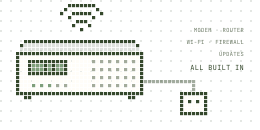
Why couldn’t AI for business work the same way?
All the complexity inside. A simple product outside.
A small box, sitting on a desk
We don’t replace specialized legal AIs: that’s their job, and the firm keeps the ones that earn their place. We replace the licenses bought to make up for the gap, and we take care of what nobody covers. A small box installed on his premises, access for every employee, and all it takes is asking: “every morning at 8, check the mailbox of the person who left and forward me anything that hasn’t been handled.” The data and the compute stay at the firm, and privileged files never leave the building. What happens inside is our job.
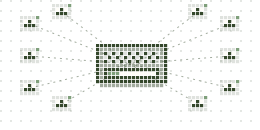
For the firm, the math is quick: €16,990 excl. VAT to buy, then €490 a month for the license, instead of €8,000 in licenses. With a level of intelligence comparable to what its teams already use, the Appliance pays for itself in under two and a half months.
AI was no longer an abstract topic but an object, something you install, buy, pay off over time and hand over to your team. That’s why the product is called Appliance.
The same need, everywhere
Since then, we’ve run into the same situation at almost every meeting. An accounting firm, a manufacturer that keeps thirty years of know-how in its files, an engineering firm, a family-owned business. All of them have sensitive data and business constraints. None of them has a team dedicated to AI, and none wants to build one.
This firm met two conditions we now look for in every client: teams that already use AI, and leaders who champion it themselves. Where both are in place, the Appliance turns an expense into an asset.
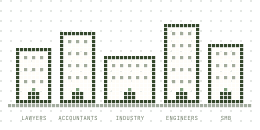
That’s who we build Appliance for. And the more we master what’s inside the box, the simpler it can stay on the outside.