Manifesto · October 15, 2026
Hello World, Appliance Labs.
The first French operator-lab for sovereign and local artificial intelligence.

· CEO & Founder · 19 min read

On 25 June 2026, I attend INIT-IA-TIVE, a breakfast dedicated to artificial intelligence at the Hub des Alpes in Challes-les-Eaux. There I meet the head of a law firm with about forty staff. We start talking about how they use AI and, fairly quickly, the conversation takes a turn that leaves me completely stunned.
For more than six months, he has been waiting for his IT provider to install Microsoft Copilot. In the meantime, his staff already use artificial intelligence tools. He knows this technology is becoming essential to stay competitive, and he does not want to watch his rivals pull ahead.
But he is also fully aware of the risks. We are talking about a law firm, with confidential files, professional secrecy and highly sensitive data. Deep down, he knows he should be careful with solutions hosted abroad, on infrastructure he does not control. Still, between waiting for the ideal solution and carrying on working, he has chosen to move forward.
Then we come to the budget. He mentions an amount of around €300 per employee per month, from memory. I do not yet have the details of the contracts or the solutions used, but for some forty people, that could mean more than €100,000 a year.
My first inner reaction? What the fuck?
I have worked in software for about ten years, and I know enough about AI technologies to know what is possible today. I find this budget completely out of proportion for a company of this size.
I finally tell him: “Listen, I could deploy something locally for you in a week that would do the job just as well for a good share of your needs. And you would not have to pay that much.”
And, frankly, I was barely joking.
The conversation stayed with me. And it reminded me of a technology I had worked on almost twenty years earlier.
Google’s yellow box.
At the start of my career, at Devoteam, a Google partner, I had the chance to work on projects around Google Search. We sold and integrated a particularly remarkable product: the Google Search Appliance.
For those unfamiliar with it, it was a big yellow server with the Google logo on it, installed directly in companies’ server racks. Google had launched it in 2002, long before the cloud became the norm.
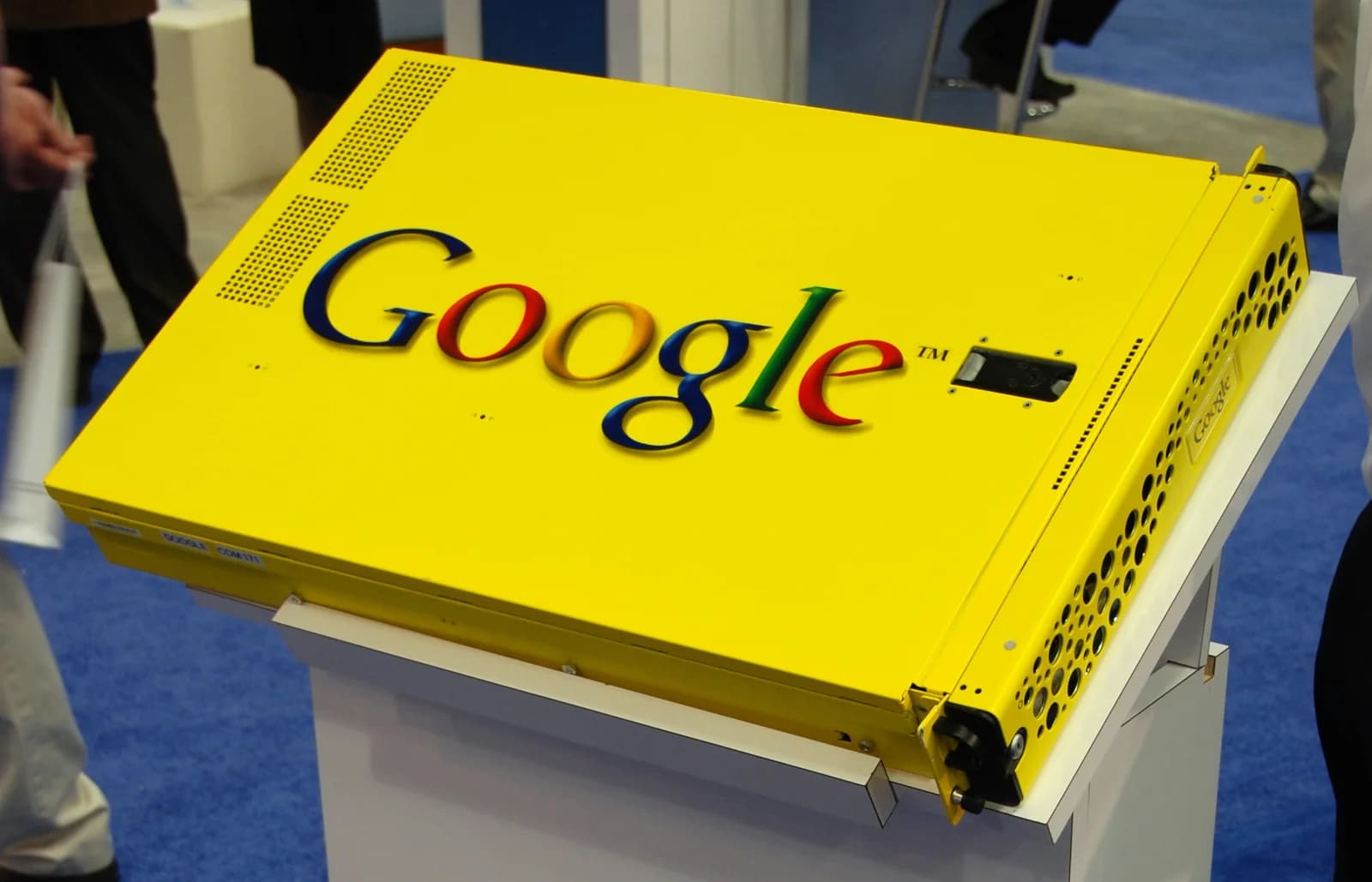
Among the clients I remember was TF1. The idea was simple: let them use the power of Google’s search engine on their own data, directly within their own infrastructure.
At the time, deploying a high-performing internal search engine was a major IT project. Google had turned all that complexity into a product you could install in a rack.
A yellow box. The power of Google Search. Your data, on your premises.
I thought the concept was brilliant.
And twenty-four years after the launch of the Google Search Appliance, thinking back to that conversation with the law firm, I asked myself a question: what if we did exactly the same thing with artificial intelligence?
Except that today, with advances in hardware and open models, we no longer even need a rack of servers. We can run advanced conversational AI on a machine compact enough to sit on a desk.
A small box, installed in the company, available to every employee, and able to run private AI locally.
That is where the word Appliance comes from.
But while thinking about the project, I quickly realised there was something far more interesting to build than a simple computer.
What if artificial intelligence needed its own operators?

Today the AI industry is full of remarkable players. Hyperscalers are building gigantic data centres, labs are developing ever more capable models, SaaS providers are adding AI to their applications, and consultancies help companies with their automation projects.
But who simply installs an AI system in a fifty-person SME, looks after it, and makes sure it works every morning?
That question brought me back to an everyday object: the broadband router.
When you fit out a new office, your IT provider installs the computers, printers, network and Internet connection. You do not ask them to explain how TCP/IP works, or to assemble your own router. You simply want your staff to be able to work on Monday morning.
And what if, tomorrow, that same provider could also install your artificial intelligence?
That is when we began to imagine a new market category: artificial intelligence operators.
Our job would not be to build a new cloud, to become a miniature hyperscaler, or to sell yet another SaaS subscription. Nor would it be to spend six months on a consulting engagement creating a few bespoke agents that nobody could maintain afterwards.
Our job would be to design, assemble, develop, deploy and operate artificial intelligence appliances. Integrated products, installed in companies, with real responsibility for how they work, their security, their maintenance and their evolution.
Like an Internet operator, but for AI.
All the complexity inside. A simple experience outside.
That intuition gave birth to Appliance Labs, a French company with the ambition of making private artificial intelligence as natural in a company as its Internet connection.
14 October 2026. This time, we have the real figures.

Nearly four months later, I speak again with the same head of the firm. In the meantime, we have started building Appliance Labs, developing its architecture and working on its business model.
This time, we go much deeper into their spending and their needs.
I then learn details I did not have at our first meeting. The firm has received proposals from specialised players such as Harvey and Legora. It also uses Doctrine, with seven licences under a three-year commitment, although only two or three are really used.
These products serve a purpose. They provide legal corpora, features and specific domain expertise. We are not trying to replace them: that is not our job, and a general-purpose assistant should not claim to offer the same guarantees as a specialised tool.
On the other hand, I learn that, having failed to get Copilot, the firm has bought forty Gemini licences, which, according to the figures he gives me, cost €200 per employee per month.
- 40Gemini licences
- €200per licence per month
€8,000 a month. €96,000 a year. For Gemini alone.
As it turns out, it is almost worse than what I had imagined in June.
Especially when he starts to describe what he would really like to achieve.
He talks to me about his emails in Outlook. An urgent message arrives, he forwards it to a colleague, flags it in red and plans to check that it has been handled. A few days later, he does not necessarily know whether anyone dealt with it. When a colleague leaves the firm, her files are redistributed, but messages keep arriving in her old mailbox. Until the day a dissatisfied client explains that they never got a reply.
He would simply like to be able to ask his AI to keep track of important email exchanges, check that no request is forgotten, prepare the necessary replies and present him each morning with the matters that need his attention.
And that is when I think: but this is exactly what we are building.
He does not need a gigantic frontier model to check whether an email has gone unanswered. He does not need colossal infrastructure to set up a follow-up routine or prepare a summary.
And at some point he tells me that they will therefore need to create AI agents.
That is when I stop him.
You do not need to create AI agents.

Why should he have to create agents? And above all, why should he need to know whether he needs an agent, a routine, an automation or simply a question and an answer?
I offer him a comparison.
When he asks an employee to prepare a file for Monday at 8 a.m., does he explain how to organise each step? Does he dictate the tools to use, the people to involve and the process to follow?
No. He explains what he expects, sets a deadline and relies on their intelligence to get the job done.
Why should it be any different with an AI?
If his request needs a simple answer, the AI answers. If it needs a daily check, it can set up a routine. If it involves consulting several sources, using different tools and carrying out actions, it can call on an agent, with the necessary permissions and approvals.
But it is not up to him to decide.
His role is to define the goal. The job of artificial intelligence is to find the right way to reach it.
He stops, looks at me, and simply replies: “Very true.”
I remember his reaction very clearly. I saw that he had just understood something. All this talk about AI agents, however fascinating it may be to engineers, was ultimately not his problem.
He did not want to learn how to create agents. He wanted to use artificial intelligence.
It is a difference that may seem subtle, but it completely changes how we think about designing a product.
We spend a great deal of time explaining to companies that they must learn prompt engineering, build workflows, choose models and create agents. But since when must you become an IT engineer to delegate a task?
Our conviction is simple: you define what you want to achieve. The AI must be able to work out how to do it.
At that point, I also present our return-on-investment simulator to him.
Using the spending he has just shared and our first price list, we calculate what replacing his forty Gemini licences with an Appliance would look like, while keeping the specialised legal software he needs.
The result is quite striking: in this scenario, the investment would pay for itself in less than two months.
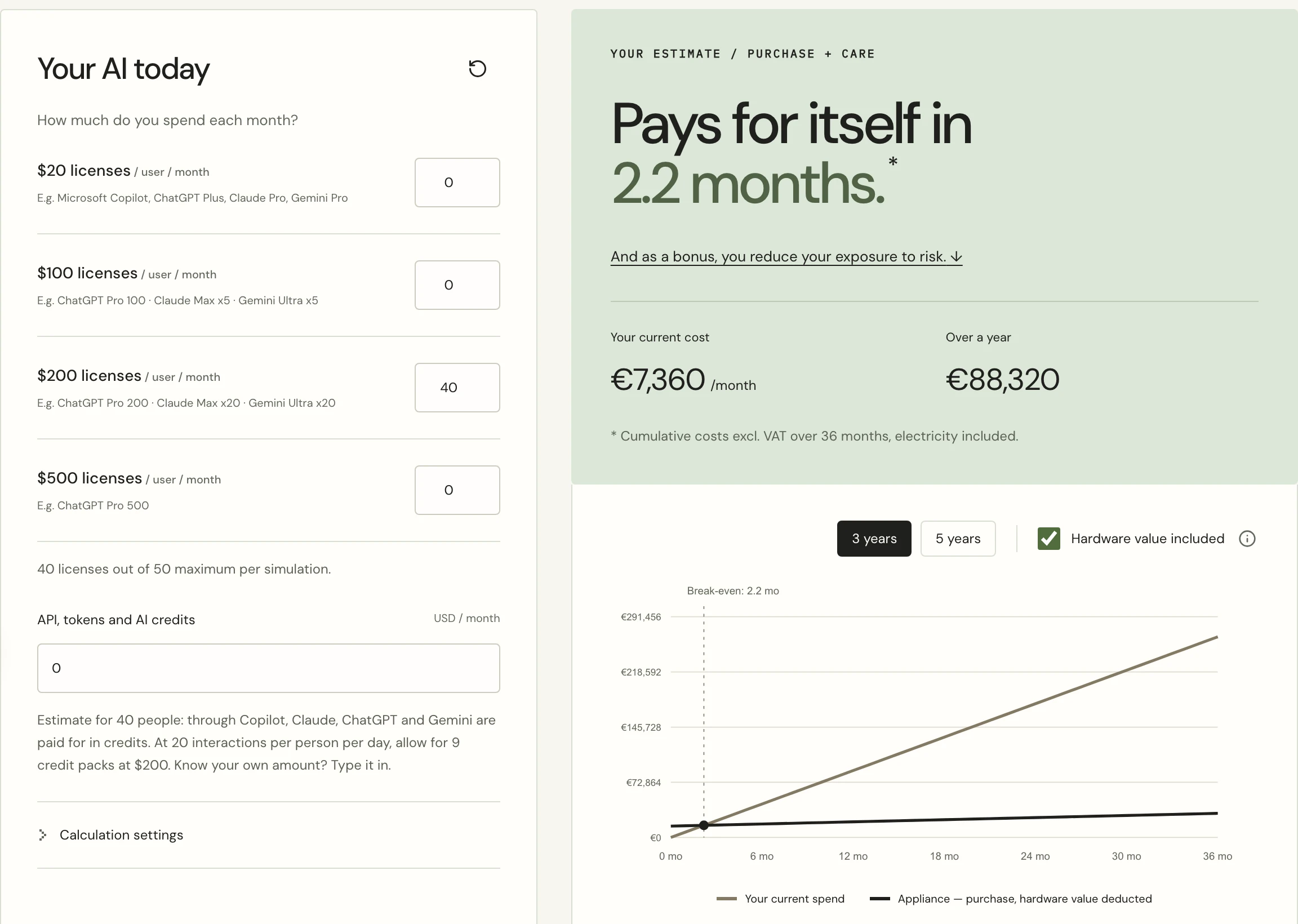
I see his eyes widen.
Of course, this calculation rests on an important assumption: our product must actually cover the relevant use cases, so that those licences can be cancelled. Not every company will see such a quick payback.
But for this firm, the contrast is striking enough for us to decide to follow up soon.
In June, I had spotted an economic anomaly. In October, I discovered that this firm’s concrete problems matched exactly what we were building.
Our intuition was starting to connect with real-world needs.
A super intelligence. On your desk.

Our first product is simply called Appliance.
It is a compact machine that runs our artificial intelligence system and that we prepare and integrate for French companies. We are starting with the NVIDIA DGX Spark, a platform small enough to sit on a desk, yet designed to run advanced artificial intelligence models.
The company has its own computing capacity, right on its premises. Its employees access a conversational application from their browser, can work with their documents, query their business tools, run searches or delegate certain tasks.
Data processing can stay local, without systematically depending on a remote inference provider. External connections, when they are needed, are governed by permissions and access controls.
And rather than adding more individual subscriptions, the company uses shared computing capacity, with no billing per token. Naturally, performance is limited by the machine’s physical resources, but the cost becomes far more predictable.
That said, it would be fairly easy to take a computer, install an open-source model on it, pick up an agentic harness on GitHub, add a chat interface and sell the whole thing as a revolution.
That is not our ambition.
We want to build a local super intelligence: a system able to combine several models, reasoning, memory, search, tools and orchestration mechanisms to carry out complex missions with limited hardware resources.
Intelligence does not come from the model alone. It also comes from how we let it work: understanding its context, selecting the right tools, checking its results and mobilising just enough power for each task.
It is a real engineering and research challenge.
And that is precisely what explains the second word in our name.
Why Labs?

Before creating Appliance Labs, I spent two years in a Franco-German artificial intelligence laboratory, alongside researchers specialising in model optimisation and compression algorithms.
I worked in particular on industrial embedded AI projects, with players such as Samsung, Huawei or the CEA. The challenge was consistently the same: how to run extremely demanding models in environments with limited memory, computing power or energy?
That experience taught me something essential: the biggest model is not necessarily the best for every task. And an AI system’s performance depends as much on architecture, optimisation and execution choices as on its intrinsic capabilities.
That is the expertise we want to put at the service of companies.
Because while the industry runs a constant race towards frontier models, which grow more powerful every week and are often more expensive to run, the needs of an SME leader are often very simple: writing an email, analysing invoices, preparing a commercial proposal, tracking their files or organising their teams’ work.
Do we really need to mobilise the largest AI infrastructures on the planet for these tasks?
We believe not.
Our laboratory develops an approach we call Local Intelligence: delivering the best possible level of intelligence on a compact local infrastructure, by choosing, specialising and optimising models depending on their use cases.
We work in particular on inference, orchestration, model selection and model specialisation. The goal is for a machine to become progressively smarter through software advances, without necessarily having to be replaced with each new generation.
But research does not stop at models.
Earlier, I mentioned our initial choice of the NVIDIA DGX Spark. To be clear: we have no intention of depending on a single hardware architecture.
We are starting with NVIDIA because this platform currently meets our initial needs. But our laboratory is hardware-agnostic. What matters is finding the best architectures to run the most capable models, with the greatest number of simultaneous users, excellent responsiveness and controlled resource consumption.
That is why we are already exploring the possibility of a research partnership with AMD, to study other hardware architectures and their prospects for local inference.
Our responsibility, as an AI operator, is not to defend a chip maker. It is to select the technologies that offer the best service to our clients, today and tomorrow.
Above all, we want to take this complexity off their hands. A business leader should not have to follow every new model published on Hugging Face, or know which GPU or architecture delivers the best performance this week.
Doing that for them is our job.
Appliance is the product we install. Labs is the research that lets us keep making it better.
This is also what should truly set us apart. A machine can be copied, and so can a conversational interface. But building lasting expertise in optimisation, evaluation, model specialisation and understanding professional uses requires continuous research work.
We do not want to simply assemble the components available today. We want to build the intelligence that will allow this new category of products to progress tomorrow.
An AI designed for French companies.

There is another fundamental difference between our approach and that of the major AI platforms.
Those platforms build applications for hundreds of millions of users worldwide. They must be able to handle almost every subject, every language and every context.
We decided to start with French companies.
We want to build AI that truly understands the daily life of a French micro-business or SME. An AI you can talk to about VAT, URSSAF social contributions, cash flow, collective agreements or public tenders, without having to systematically explain how our administrative and economic environment works.
To that end, we are developing a research programme dedicated to specialising open models for French professional uses, as well as a dataset we have named Appliance Labs France, which we plan to publish very soon on Hugging Face.
We are particularly interested in the work of Compar:IA, French institutional resources, the initiatives of Pleias and various administrative, scientific and economic corpora. The aim is to assess how these resources, when they are suitable and can be used under their licences, can improve understanding of French professional situations.
We believe that a smaller model, properly specialised and supported by the right tools, can be just as relevant, or even more so, on certain specific tasks as a much larger general-purpose model.
This remains a hypothesis to prove, with real evaluations. That is precisely the work we want to do.
But model quality does not solve everything. Another major obstacle to AI adoption remains: knowing what to ask it.
The conversational interface is probably one of the simplest interfaces ever developed in computing. No need to learn hundreds of menus or buttons. You simply state a request.
Yet, faced with an empty text field, many employees do not know what this technology could do for them.
So we are building a library of professional use cases directly into Appliance Chat. Our first selection contains 55, covering nine business areas, from commerce to finance, including accounting, legal, human resources and operations.
The user chooses a situation that speaks to them, describes what they want to achieve, and the application guides them. This library is then meant to evolve with the needs encountered in the field, so that good methods can be shared between companies without exposing their confidential information.
Because we believe the real value of AI will be measured not only by what it is theoretically able to do, but by what it actually allows employees to accomplish.
What if AI finally became an investment, rather than a recurring expense?
There is one last aspect of our approach that particularly excites me: its business model.
For about fifteen years, we have gradually turned almost all our software into subscriptions. This is the era of SaaS, per-user licences and monthly invoices that rise as the company grows.
Artificial intelligence has only amplified this trend. Today, you can quickly find yourself paying tens, even hundreds, of euros per month per employee, without ever owning any part of the infrastructure that makes these services work.
We offer another possibility: turning part of a company’s AI spending, traditionally operational (OPEX), into a hardware investment (CAPEX).
By choosing to buy an Appliance, the company acquires computing capacity it can use for several years and depreciate in its accounts. Operating, maintenance and energy costs naturally remain, but the economic logic changes: instead of paying only for access to AI, it invests in infrastructure it owns.
And there is an interesting feature.
Unlike static software, an Appliance can become more capable over time. Models improve, optimisation techniques progress, and our software layers evolve. On identical hardware, we want to be able to deliver more intelligence in two years than today.
In other words, even when the accounting value of the equipment falls with depreciation, its value in use can keep rising.
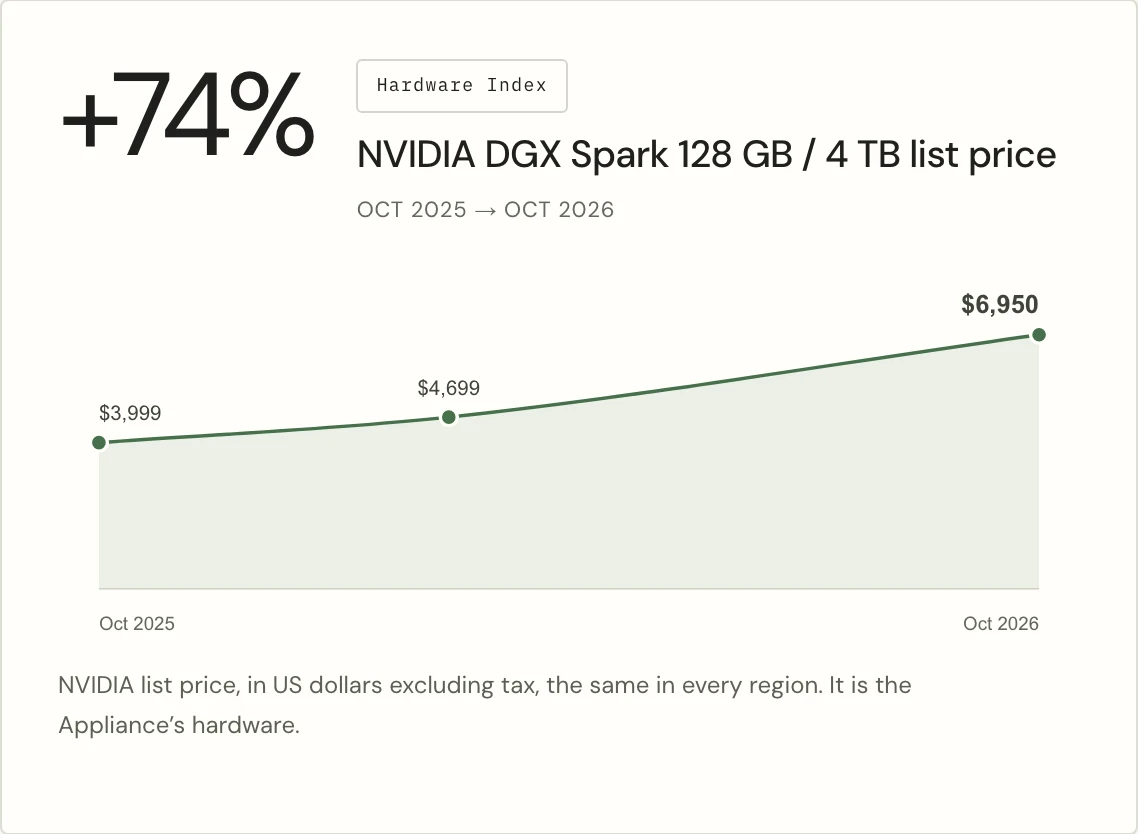
There is also a residual hardware value. And recent strains on the memory and computing component markets remind us that the replacement cost of this infrastructure can change considerably, sometimes upwards. This does not guarantee that a second-hand machine will be worth more than its purchase price, but we think this dimension deserves serious study.
That is why we are developing our Appliance Value Index, an index designed to track the economic and hardware value of our machines, together with return-on-investment calculation tools.
And we want to apply the same principle to environmental impact.
It would be too easy to claim that local AI is always more environmentally friendly than AI hosted in the cloud. A machine has a manufacturing footprint, consumes electricity and uses hardware resources. But gigantic AI infrastructures also carry a considerable energy and environmental cost, which is sometimes hard to measure precisely.
In a first internal simulation, we estimate a potential reduction of 69% in CO₂e emissions over three years, for thirty employees, compared with the cloud scenario studied. That is encouraging, but the result depends on assumptions about consumption, use, lifespan and the services compared.
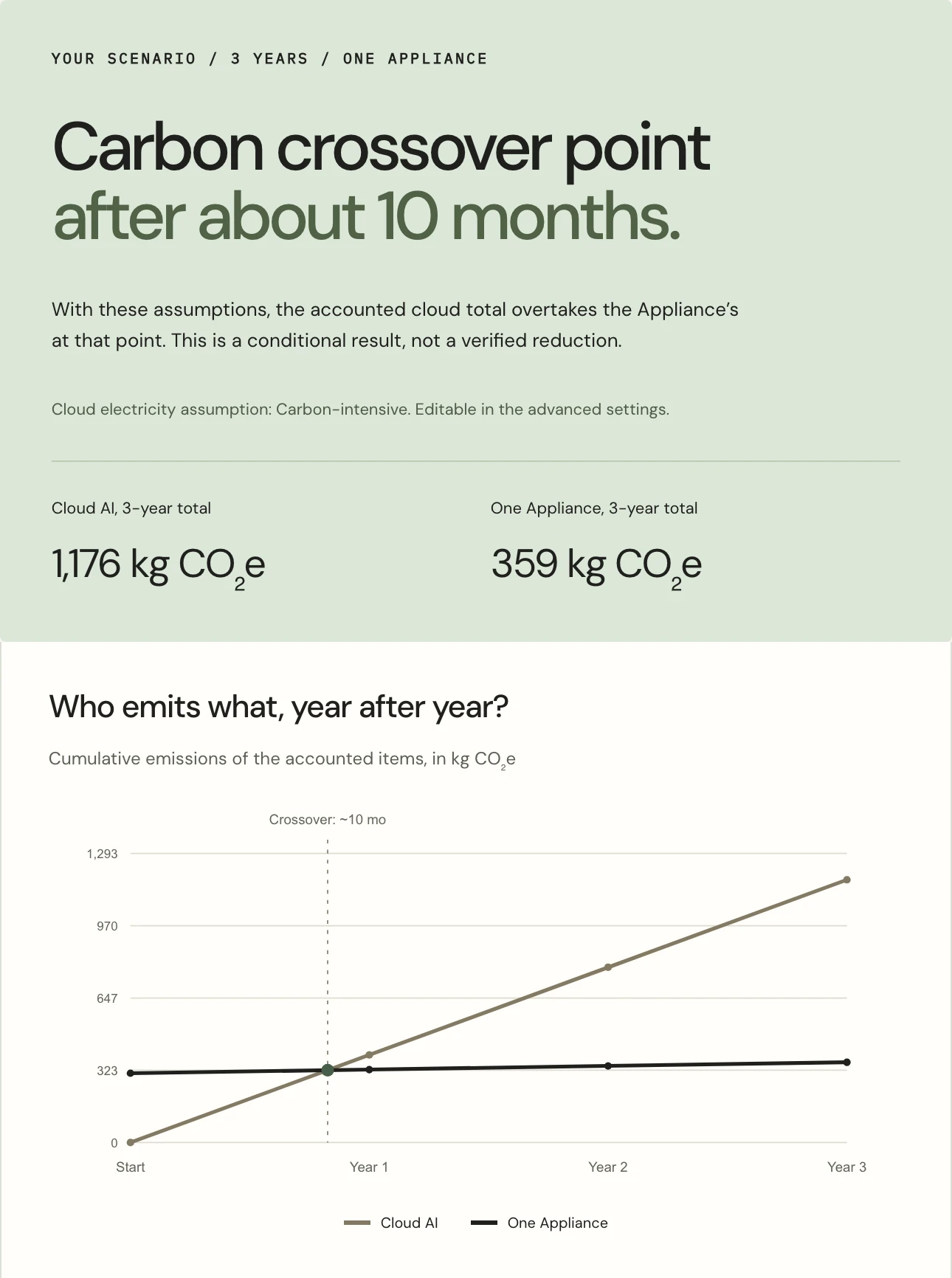
Our ambition is to make these calculations transparent, to publish our methods and to gradually test our assumptions against real-world measurements.
We want to build an observatory that will let companies understand what their artificial intelligence costs them, what it brings them, how its value evolves and what footprint it generates.
Because sovereignty, performance, economics and the environment should not be mere marketing claims. They are things that can be measured.
And because we believe an artificial intelligence infrastructure should be able to become a lasting asset for the company, rather than an expense it depends on indefinitely.
Hello World.
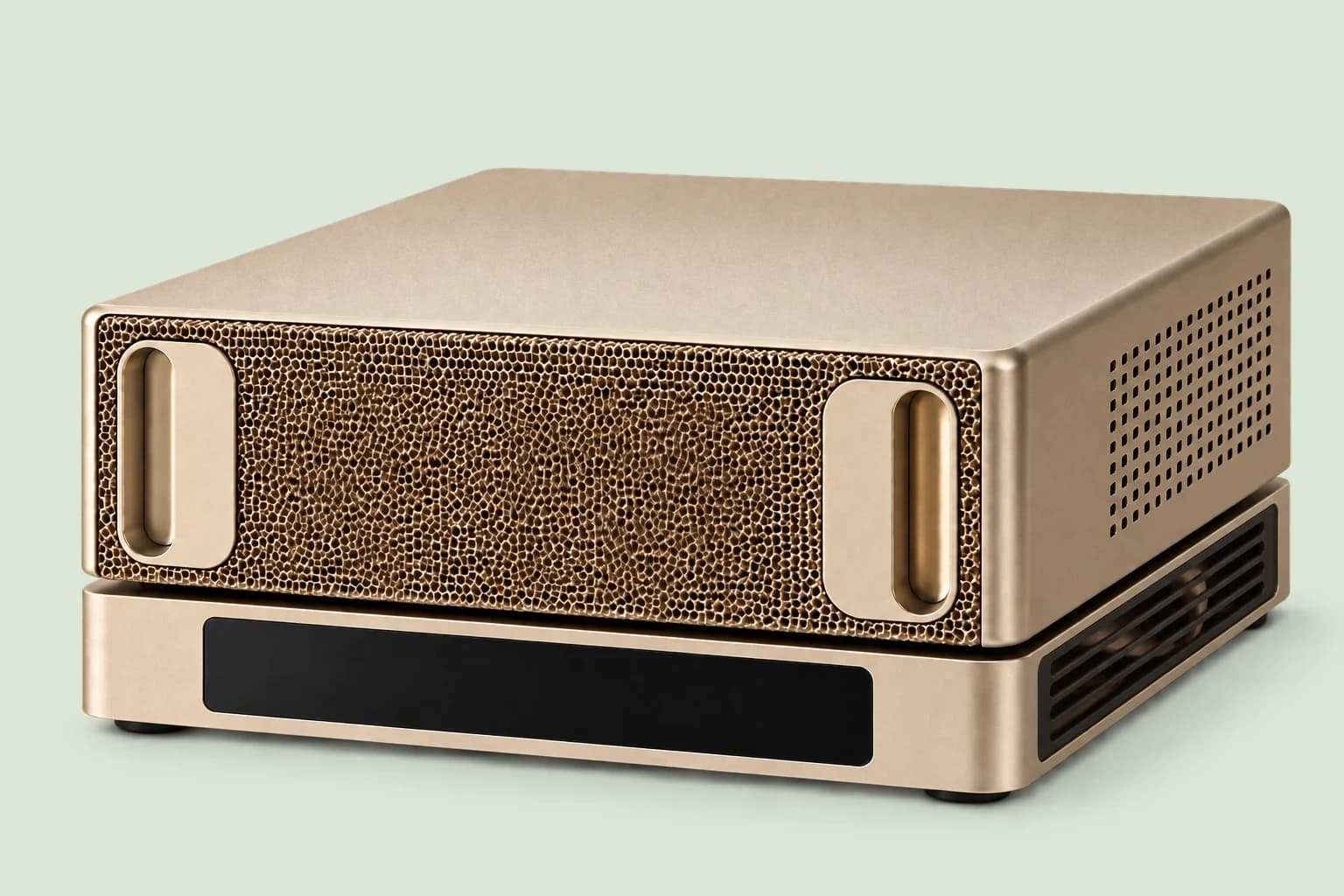
When I think back to that first conversation with the head of the law firm, I realise that what struck me most is not, in the end, the staggering amount of his AI spending.
It is the moment, a few months later, when he understood that he did not need to know how to create agents to benefit from AI.
He simply needed an intelligence to which he could entrust his goals.
Technology should let him focus more on his profession, not force him to learn a new one.
That is exactly what we want to build with Appliance Labs.
An artificial intelligence operator able to provide French companies with private, local, specialised AI, continuously improved by a genuine research laboratory.
A new category of professional infrastructure, as natural tomorrow as an Internet connection is today.
We are only at the beginning. There are still many models to optimise, hypotheses to test, performance to measure and products to build.
This blog will be our laboratory notebook. We will share our experiments, our technical choices, our benchmarks, our successes and our mistakes. Not only to talk about our product, but to document what becomes possible when artificial intelligence truly comes closer to the people who use it.
Twenty-four years ago, Google put search in a box.
In 2026, we decided to put artificial intelligence in one.
And to build the whole profession that goes with it.
A super intelligence. On your desk.
Hello World. Welcome to Appliance Labs.
Quentin SinigCEO & Founder, Appliance Labs