Manifesto · November 18, 2026
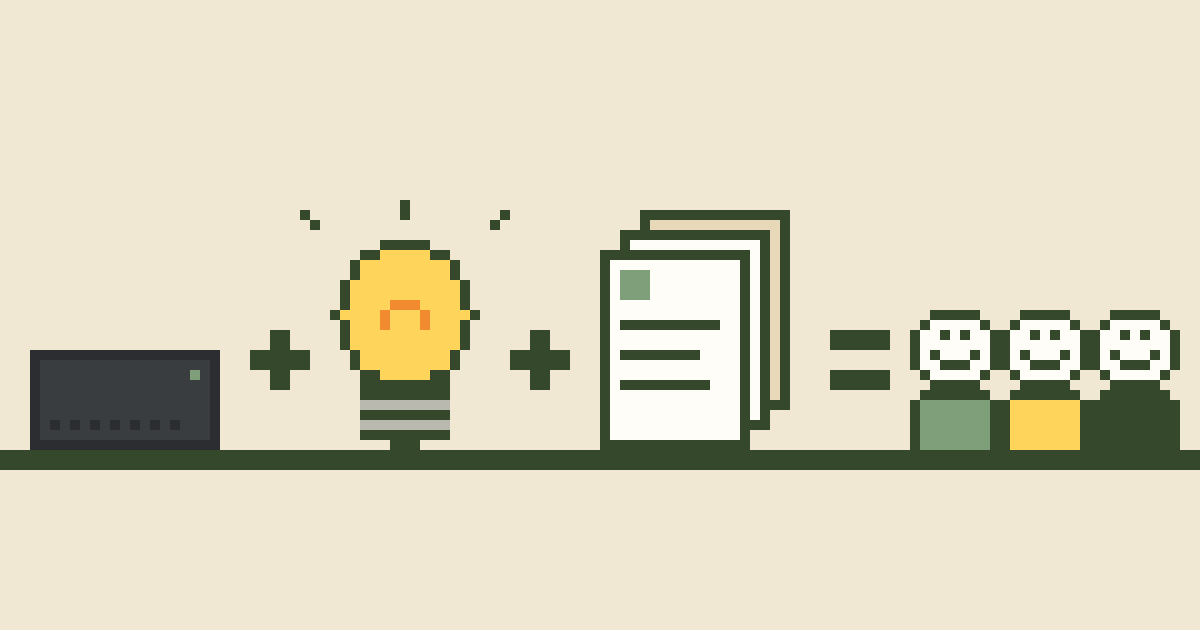
Hardware + Intelligence + Use cases = AI adoption.
AI adoption rests on 3 conditions: peace of mind, trust and accessibility. 3 pillars, 3 different problems, and none is enough without the other 2.

· CEO & Founder · 21 min read
Since we started building Appliance Labs, I have had the chance to talk with leaders of very small businesses, SMEs and mid-sized companies, but also with professionals from the public sector. Different trades, and organisations ranging from 10 to several hundred employees. And yet the same questions keep coming back.
Where does our data go when we use artificial intelligence? How do we keep costs from exploding if the whole company starts using it? How do we know whether the answers are relevant? And above all, how do we make sure our employees actually use it?
What strikes me is that these questions are different from the ones that drive the AI industry day to day.
We spend our time comparing the latest frontier models and their scores on benchmarks. Meanwhile, the head of a 50-person SME wants to know whether they can give their whole team access to an AI without compromising their data, without piling up subscriptions and without asking their employees to become AI experts.
At Appliance Labs, we hold a conviction: putting boxes in offices will not be enough to move AI adoption forward. That would be too easy. For us, AI adoption rests on 3 conditions: peace of mind, trust and accessibility. That is why we decided to build our product around an equation:
Hardware + Intelligence + Use cases = AI adoption.
Hardware brings peace of mind: a private, sovereign AI with predictable costs. Software brings trust: frontier-level intelligence, continuously improved by our lab. Use cases bring accessibility: an experience that lets everyone discover what AI can do for them, without trying to become an expert in it.
3 pillars, 3 different problems. And our conviction is that none of the 3 is enough without the other 2.
1. Peace of mind through hardware
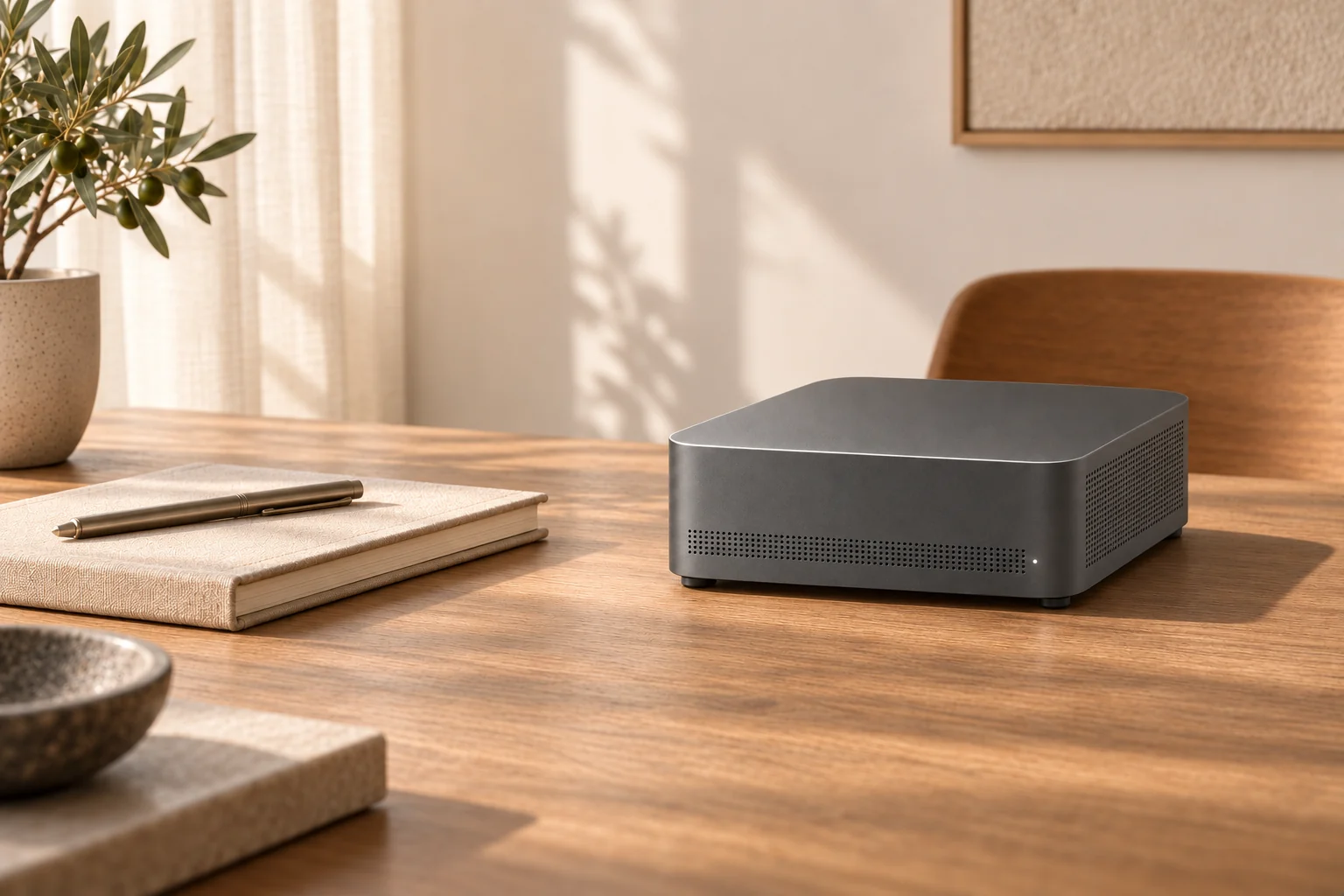
I say it often: there is nothing more sovereign than a box sitting on your desk. But why are we so attached to this idea?
Because when a very small business, an SME, a mid-sized company or a public administration considers deploying artificial intelligence, 2 concerns come up: data confidentiality and cost control.
First question: where does our data go?
In bank branches, law firms, accounting firms and town halls, artificial intelligence raises as much interest as it does questions. And among them, one keeps coming back: what happens to our data when we use AI?
According to the France Num 2026 Barometer, 53% of the leaders of small businesses and SMEs fear losing their data or having it hacked. This figure illustrates a concern that takes on particular weight when you consider entrusting your business data to an AI model.
Because this fear has a consequence: it slows adoption down.
A leader can be convinced of AI’s potential and still hesitate to deploy it. An IT manager may prefer to restrict usage rather than take a risk they do not fully control. Employees may give up using AI with work documents for fear of putting their job at risk.
And yet, what is the point of using artificial intelligence if you cannot connect it to your emails, your documents and your business tools?
None.
That is the whole paradox. For AI to bring value, it needs access to the information we work with. But that is often the very information organisations hesitate to hand over to it. That is why we chose a different, physical approach: putting artificial intelligence directly inside the organisation, on a box sitting on its desk.
This sovereignty also brings concrete independence. On 12 and 13 November 2026, Microsoft 365 suffered an outage that disrupted Outlook and Copilot in particular. The same day, Claude also went through several service interruptions, while its Microsoft 365 integration was affected. With an Appliance, your AI would have kept running locally, even while some external services had become unreachable. That too is sovereignty: not making all of your intelligence depend on the availability of an outside provider.
Second question: how much will it cost us if everyone joins in?

There is a paradox in AI adoption. We tell leaders they should encourage their employees to use AI more. But we offer them business models in which every million tokens consumed can raise the bill, sometimes even regardless of their usage, because of technical changes made by their providers. We documented this in our dossier AI sovereignty: two extreme cases, one dependency.
And it is all the more paradoxical because the productivity gains are documented. In a study published in Science, MIT researchers observed an average 40% reduction in the time needed to complete certain professional writing tasks, with an 18% improvement in the quality of the results. In France, the France Num 2026 Barometer reports that 68% of small businesses and SMEs using AI consider that it has a positive impact on their activity. The Banque des Territoires, in an article published in November 2026, describes local authorities that already see time savings but still struggle to quantify them.
Indeed, a productivity gain does not automatically turn into a financial return on investment. And that is the whole difficulty for leaders: how do you justify and forecast a spend whose benefits build up gradually, when the bill can change from the very first months?
The risk exists in large companies too. In 2026, Uber’s chief technology officer acknowledged that the company had exhausted its annual AI budget within a few months, before reworking how it managed and optimised consumption.
The consequences are the same: when employees adopt AI on a large scale, the organisation may find itself having to release extra budget, impose token quotas or stop some uses. Conversely, if it provisions too generously, it ties up budget without knowing whether it will get enough value out of it.
The more adoption succeeds, the harder it can become to keep under financial control. It is absurd. Just when adoption starts to work, we put the brakes on it.
We are not arguing that you should spend without counting to democratise artificial intelligence. We believe adoption must rest on a coherent and predictable economy, one that lets leaders commit for the long term without fearing that the success of their first use cases will put their budgets at risk.
The parallel with the cloud
This difficulty in anticipating costs reminds me of another transformation in IT: the arrival of the cloud in the 2010s.
Before founding Appliance Labs, I was a solutions architect at Upsun, formerly Platform.sh. My job, in pre-sales, included what is called right-sizing: sizing our customers’ infrastructure needs as accurately as possible, without over-provisioning and without the risk of running out of resources.
For 7 months, I talked with the technical teams of IT departments to understand their applications and anticipate their cloud resource needs. And one thing struck me: even IT departments, for the most part, cannot define their resource needs precisely, let alone anticipate them.
So imagine asking an SME that is just discovering artificial intelligence to do the same exercise. How could it forecast its token consumption over 12 months when it does not even know what new uses its employees will have invented in 3 months?
We ask companies to roll out a technology across the board while requiring them to predict in advance how much they will use it. That is the contradiction we want to resolve with hardware.
With our Appliance, the promise is simple: a maximum number of users set in advance, no yet-another individual subscription and no token cap imposed on each employee.
We can therefore offer unlimited use, with no per-token billing, within the planned number of users. We do not want a leader to wonder whether their employees are using artificial intelligence too much. We want them to wonder how to let them use it more, and better.
What if AI became an investment again rather than an expense?
Hardware has one last advantage. With hardware, the company no longer just pays for access to artificial intelligence. It invests in an asset it owns. Where subscriptions and APIs are generally operating expenses, buying the hardware can be booked as an investment, in other words CAPEX, with the possibility of depreciating it over several years and benefiting from the applicable tax deductions.
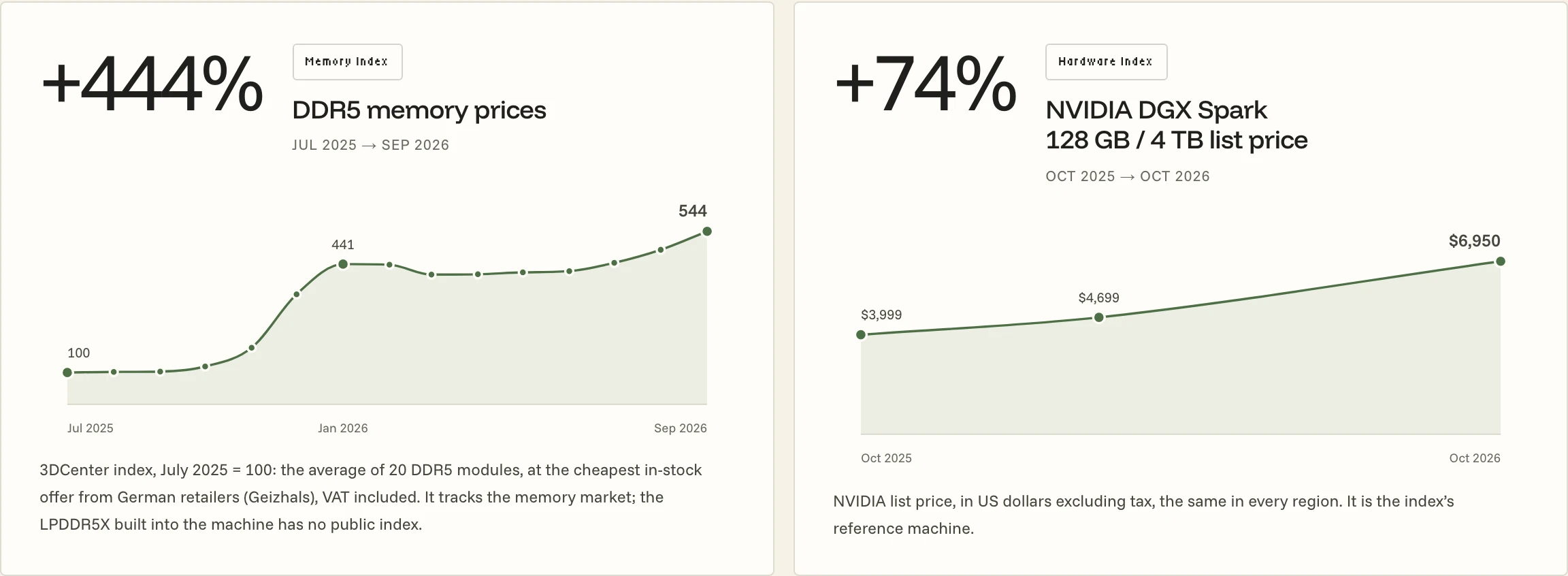
Usually, when a company buys a car, a printer or a computer, it knows the equipment will gradually age and lose value. With AI hardware, we observe the opposite: some equipment sees its replacement cost rise, while its value in use can keep growing thanks to software improvements, even during its depreciation. We document this in our Observatory with the Hardware Value Index, dedicated to how prices of new AI hardware and memory evolve.
That is the icing on the cake of our first pillar: peace of mind through hardware. But owning a machine, sovereign and economically attractive, is not enough. The intelligence it carries still has to be up to the task.
2. Trust through intelligence

Once the hardware question is settled, another remains, one that obsesses us at Appliance Labs: how do we make our local intelligence as relevant as ChatGPT or Claude?
Because sovereignty, confidentiality and cost control are not enough to guarantee adoption. If employees get better results with the assistants they already use, why would they change their habits?
So our ambition is not to run an artificial intelligence model on a small machine. We want to bring local intelligence closer to that of the best frontier models, on the professional tasks we target. That is our lab’s thesis: Local Frontier Intelligence.
And to understand our approach, you first have to separate 2 notions that are often confused: a model and an intelligence.
A model is only part of the iceberg
It provides capabilities for understanding, generation and reasoning. But the quality of the work done also depends on the information it can access, the tools it knows how to use, its memory, its instructions and the way the whole is orchestrated.
That is why, at Appliance Labs, we work on the models, their weights, compression methods, optimisation algorithms, fine-tuning, adapters and all the software engineering around them: context, memory, tools and the harness. MIT’s work on modifying weights and NVIDIA Research’s work on context compaction feed into this approach.
Model specialisation is one illustration. Airbnb has just published a benchmark in which its engineers specialised a small model for a classification task. It reaches a quality comparable to that of the best OpenAI or Anthropic models tested on this task, running about 26 times faster, all at a running cost of around 1% at high volume.
The demonstration is clear: with the right specialisation and the right engineering, a small model can reach the quality of frontier models on a specific task, for a fraction of the resources.
That is our whole conviction: the performance of an intelligence does not depend only on the power of the model, but also on how it is optimised and put to work. The model provides part of the intelligence. The system gets the best out of it.
An intelligence designed for French realities
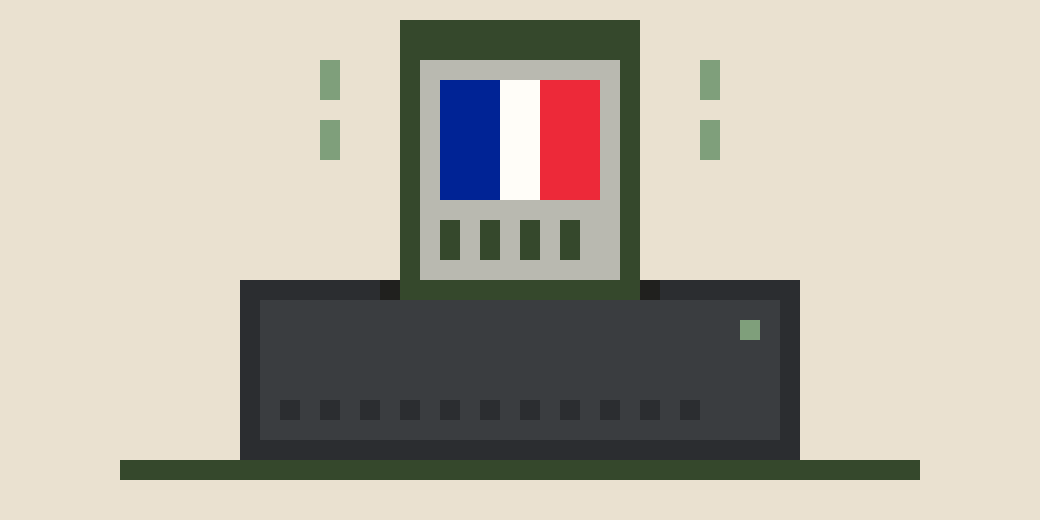
We also want this intelligence to be more relevant for French professionals. An international model can be excellent in many fields, yet lack the right reflexes when faced with the particularities of our administration, our economy or our professional practices.
That is why we are working on a France adapter.
The idea is to aggregate, select and compact knowledge from French reference sources, such as INSEE, Service-Public.fr, PLEIAS, DINUM or Etalab, in line with their licences. We are designing this adapter so that it can be combined with different models, without systematically retraining all of their weights.
This approach lets us stay model-agnostic. Whether the provider leading the AI race is American, Chinese or European, our goal is to have a reusable France adapter, able to give it the references it needs to better understand French realities.
And this work is only part of our lab’s role.
Our lab has to keep up with the AI race. Not our customers.
Developing a relevant intelligence is one thing. Keeping it relevant over time is another. Today, new models appear almost every week. Optimisation techniques progress, architectures evolve, and what was state of the art 6 months ago may already be outdated.
Keeping up with that pace, evaluating new models, comparing their performance and integrating the relevant improvements is a full-time job. It also takes specialised expertise.
That is not the job of a very small business, nor of an SME or a mid-sized company.
Good news. It is ours.
In the field, we observe one reality.
Some companies have Microsoft Copilot licences, but their employees rarely use them, for lack of convincing results on their tasks. Others have deployed internal assistants whose models have not been updated in months. And when the approved tools are not up to the task, employees sometimes find their own solutions.
We have met employees who use ChatGPT or Claude from their personal computers, then transfer the results to their work tools. We have even seen employees go through Google Search’s AI Overviews to reach Gemini’s capabilities indirectly, despite the restrictions imposed by their organisation.
These practices are not without risk, but they reveal a problem: when the intelligence provided no longer meets its users’ expectations, it loses their trust. And employees go elsewhere for the performance they need.
You might then think it is enough to deploy a better internal assistant. But that raises another problem. We talked with an IT team that needed about 6 months to evaluate and approve a new model in its environment. 6 months, in an industry where models change almost every week. And I do not blame them.
For years now, we have been asking IT departments to master ever more complex information systems. They have to manage security, applications, networks, identities, data and cloud environments whose technical demands keep growing. Now we are also asking them to become experts in language models, quantisation, fine-tuning, inference engines, benchmarks and the orchestration of artificial intelligence.
We cannot ask every IT department to become an AI lab. It would require specialised skills, considerable human investment and the ability to keep up with this industry’s pace of innovation.
That is Appliance Labs’ reason for being.
Our job is to follow scientific advances, experiment with models, benchmark the different approaches, optimise their performance and integrate the relevant improvements into our software. And to do it continuously.
An Appliance installed today has fixed hardware resources, but that does not mean the capabilities of its intelligence must stay frozen for 3 or 5 years. New, more efficient models, better compression methods or software optimisations can make its capabilities progress without systematically renewing the hardware.
We want to offer our customers the essence of an artificial intelligence lab, without them having to build their own. That is what the word Labs in our name means.
And that is how we see trust: offering a high-performing intelligence and continuing to improve it so that it keeps earning its users’ trust.
But even with a high-performing intelligence, one obstacle remains. How do we make sure employees know what to do with it?
3. Adoption through use cases
With hardware, we bring peace of mind. With intelligence, we build trust. These 2 pillars create the conditions for adoption. What remains is making sure employees take ownership of this technology.
And on this point, we have an advantage: artificial intelligence is a recursive technology: it can teach us how to use it. You do not know how to do a task? Ask it. You are unsure which method to use? Ask it. You do not even know where to start? Ask it that too.
10 or 20 years ago, learning to use software like SAP or Salesforce could mean long training courses, PowerPoint presentations and hours spent understanding its menus, buttons and workflows.
With AI, the experience changes. You no longer need to master hundreds of screens to get started. You can talk with it. And that is why we take a stance at Appliance Labs: we believe more in learning by doing than in theoretical training. But we will come back to that.
Because despite this simplicity, one problem remains that general-purpose assistants like ChatGPT, Claude, Gemini or Copilot do not fully solve.
Blank page syndrome

Imagine an SME employee or a public-sector agent opening their AI assistant for the first time. They may already have used Gemini on their phone, asked ChatGPT a few questions or turned a photo of their cat into a Simpsons character. But now they are at work, in front of an empty chat window. And they wonder: “Right, what can I ask it?”
They know they can ask it questions. But do they know they could use it to prepare meeting minutes, compare different versions of a document, rephrase an administrative letter, analyse a procedure or organise information from several files? Not necessarily. They lack neither intelligence nor motivation. They lack examples that match their job.
That is what we call blank page syndrome. And we think it is one of the underestimated brakes on AI adoption.
We give employees access to a technology capable of many tasks, then ask them to imagine for themselves everything they could do with it. Some manage naturally. Others do not know where to start, or stick to a few uses. That is the problem we want to solve with ApplianceGPT, the application that gives our users access to their local intelligence.
We took a familiar interface, close to ChatGPT, Gemini or Claude. A conversation, documents, a history. We have no reason to reinvent an experience millions of people already know. But we added an extra layer of abstraction: use cases. 10 jobs, 113 use cases and more than 250 skills.
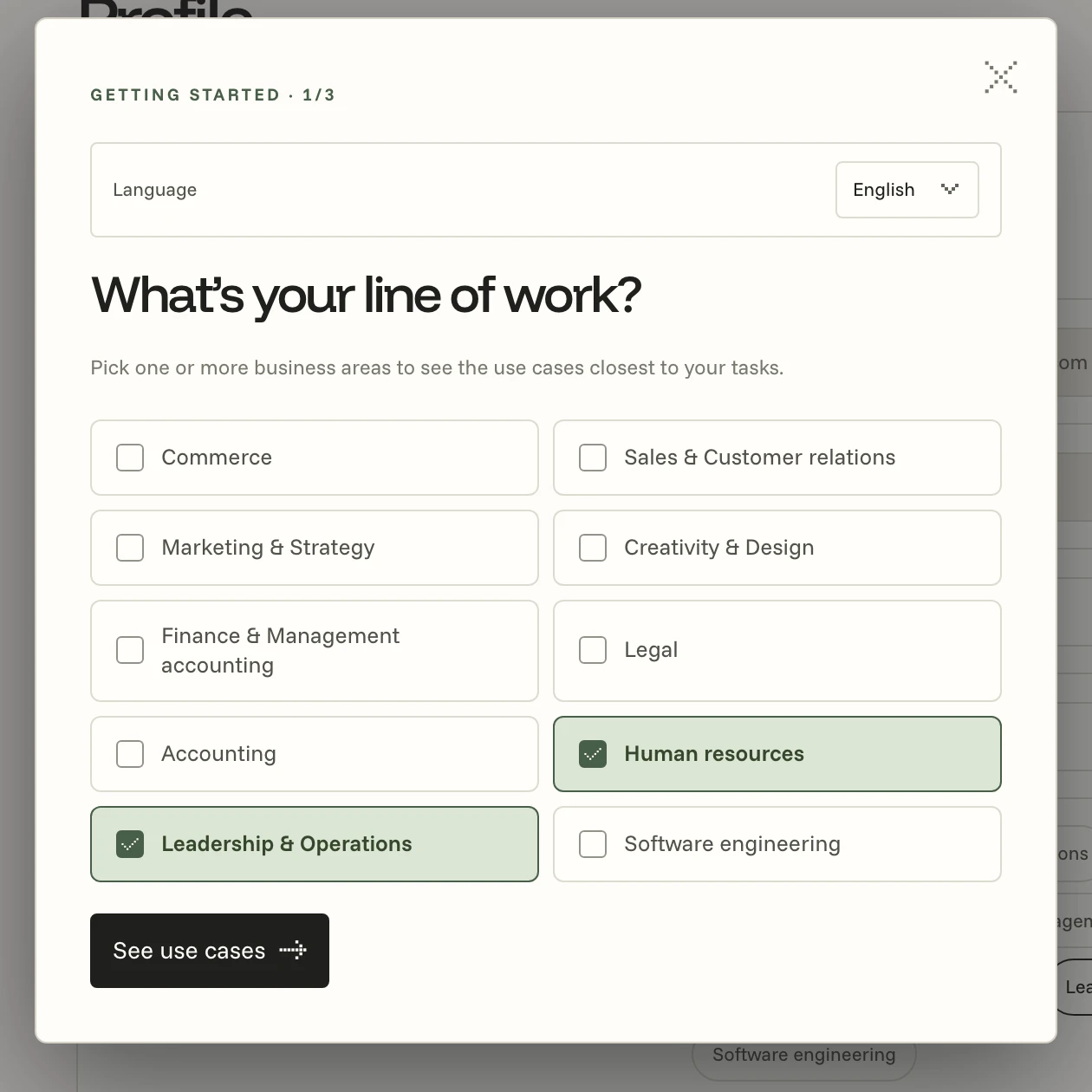
We organised this experience around use cases, rather than around skills or agents. The distinction matters. ChatGPT or Claude already let you add skills, custom instructions and various tools. But for many SME employees and public-sector agents, the very notion of a skill is already too technical.
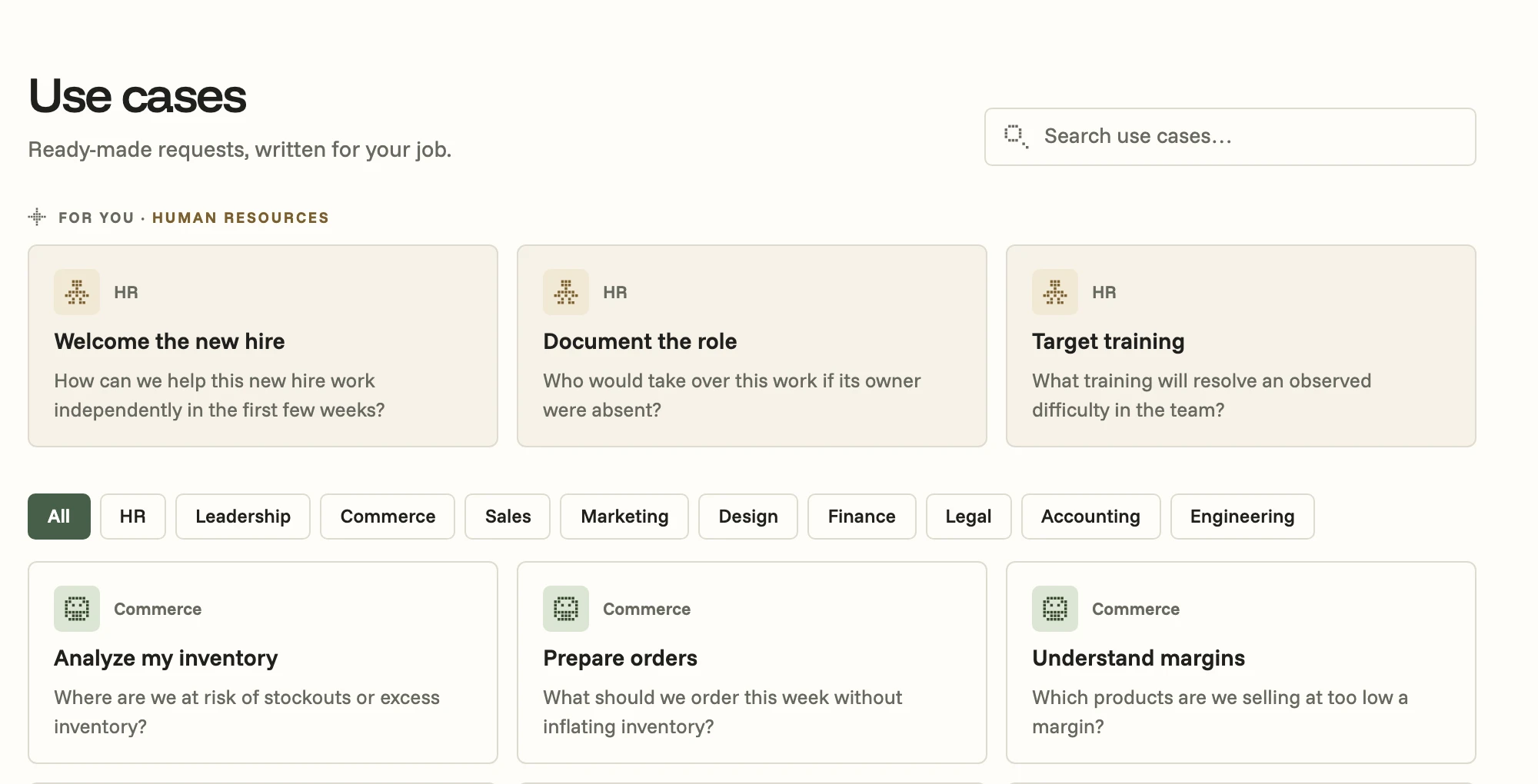
Why should an HR assistant know which skill to install? Why should a company head understand what an agent is? In working life, nobody operates like that. When you ask a colleague to prepare a report for Monday morning, you do not start by explaining which software they will have to use, how many searches they will have to run or how they should split up their work. You explain the expected result. We carried this philosophy into our product. The user picks their use case. ApplianceGPT handles the technical complexity needed to carry it out.
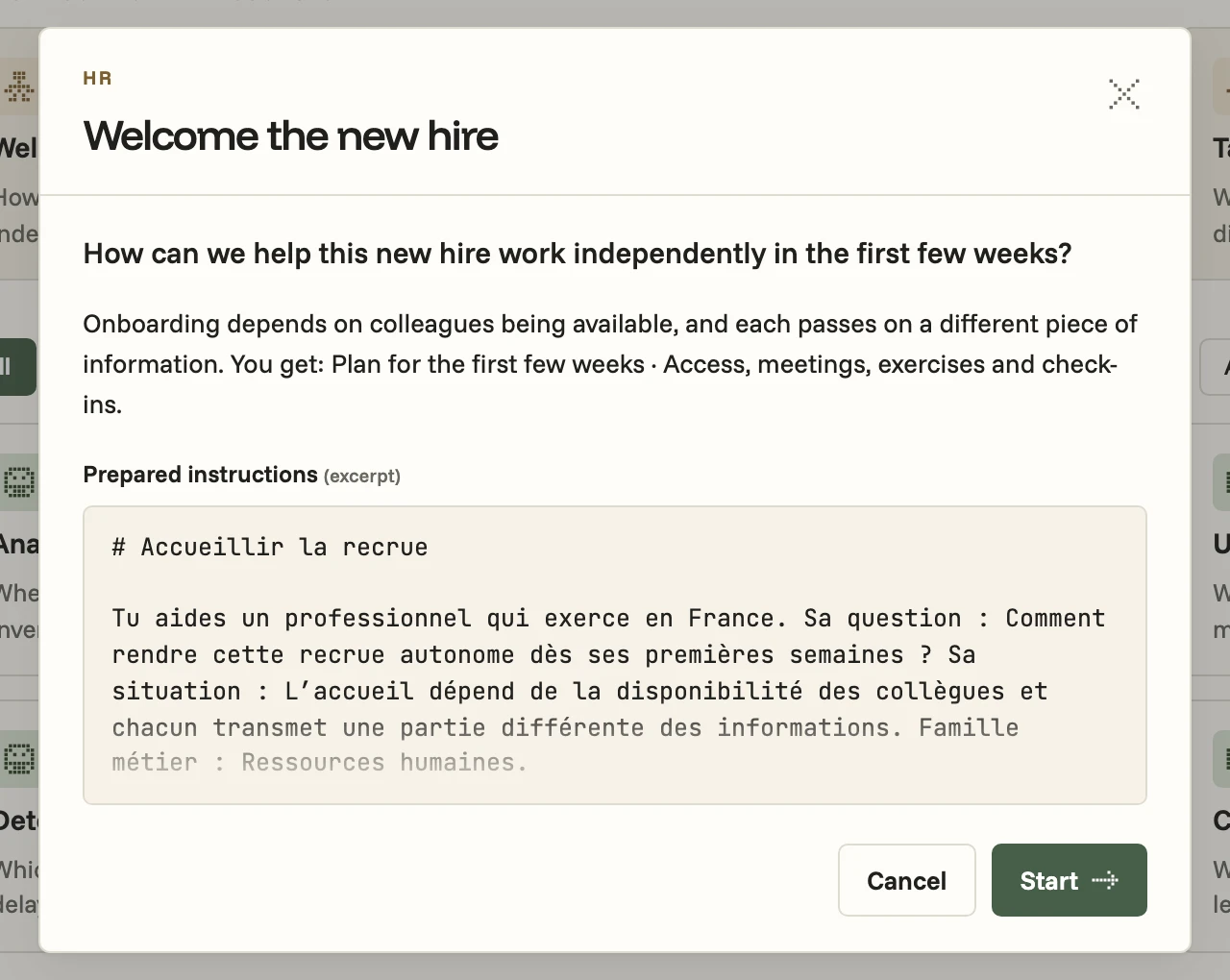
Behind a single catalogue of use cases, different mechanisms can be at work.
A simple prompt, when a task only needs a question and answer enriched with instructions and context. An automation (or “routine”), when a piece of work has to run at regular intervals, such as preparing an information summary every Monday morning. Or an agent, when a mission needs several steps, different tools and possibly several sub-agents working in parallel. Technically, these 3 mechanisms are different. But for the user, it should make no difference. Complexity must live inside the product, not in the experience of the person using it.
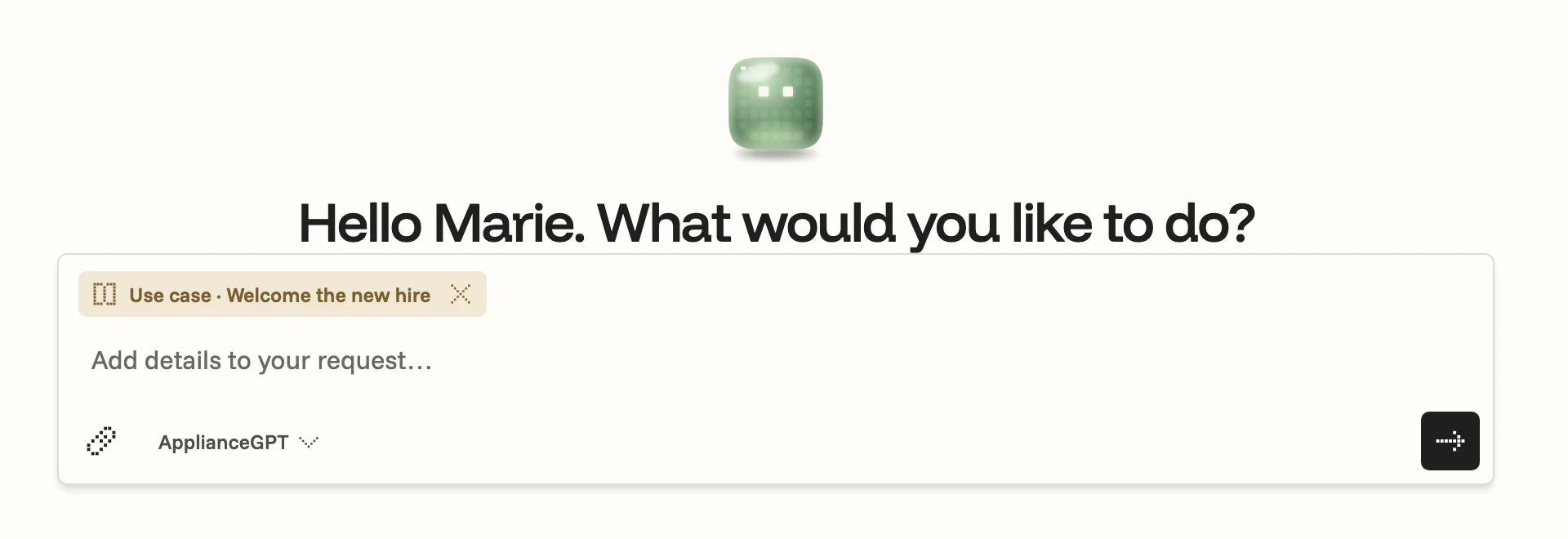
And once their first use case is done, the employee can go further: adapt the instructions, ask follow-up questions, customise certain methods and discover new possibilities. That progression is what interests us. The point is not to turn every employee into an artificial intelligence expert, but to let them discover what they can achieve in their own job with it.
Building on the company’s use cases and skills
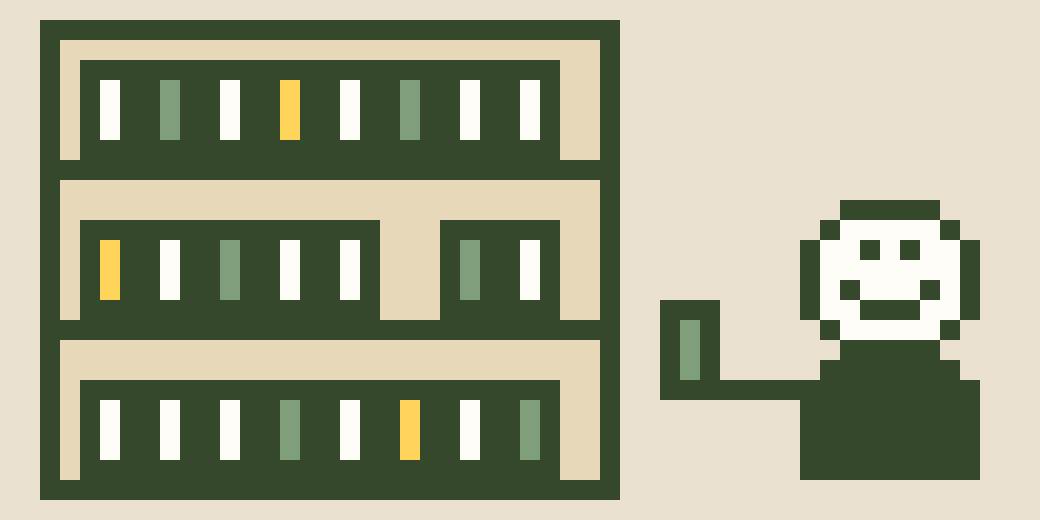
There is another dimension to this approach when you stand in the leader’s shoes. Every day, employees develop methods, skills and know-how specific to their job. Much of this expertise lives in their personal experience, their work habits or knowledge that has never been written down. And when an employee leaves an organisation, part of that know-how risks leaving with them. With AI, we have the opportunity to change that.
By letting employees formalise their methods as reusable use cases and skills, we want to give companies the means to build on the expertise developed in the course of their business. And everyone wins.
For the employee, it is also a lever for employability. Today, some leave their company keeping documents to hold on to a record of their expertise, despite the confidentiality issues this raises. Tomorrow, we think CVs will be complemented by skills portfolios, showcasing that know-how.
For the company head, AI is no longer just an individual productivity tool. It also becomes a way to build on the company’s skills and pass that expertise on over time.
Certified use cases

When it comes to designing use cases, we have one piece of advice: do not take our word for it. At Appliance Labs, we know how to design agents and optimise models. But that does not automatically make us experts in law, accounting, human resources or public administration. And we have no intention of pretending otherwise.
That is why we want our use cases to be progressively reviewed and approved by trusted external third parties, specialists in their fields. Their role is to check that the proposed methods match the realities of their profession, that the necessary precautions are built in and that the limits of AI are defined.
Our lab makes sure the intelligence is up to the task. Our independent domain experts help check that it is used wisely. That is how we want to complete our chain of trust: the peace of mind brought by hardware, the relevance of the intelligence developed by our lab and the validation of use cases by those who know the trades.
We do not believe in training

There is one last conviction we stand by at Appliance Labs. We do not believe AI will be democratised by multiplying PowerPoint training sessions and prompt engineering courses. Artificial intelligence already has the recursive quality we mentioned earlier. And it evolves at a pace that quickly makes theoretical programmes obsolete.
You do not learn to use AI only by listening to someone explain how it works. You learn above all by trying to get it to do something. That is why we favour a hands-on approach, inspired by the Forward Deployed Engineers model.
This approach has a second advantage for our lab. Every collaboration lets us understand what works, what fails, the needs we had not thought of and the improvements our product needs. These are all feedback loops that help us enrich our library of use cases. The more we work with users, the more we build a product grounded in the reality of their jobs.
We understand that some organisations need more: change management. A human and organisational undertaking that can take several months, sometimes several years. It is a profession in its own right. It is not ours.
That is why we work with specialised partners in a three-way relationship with our customers when needed. Our lab brings the intelligence. Our trusted third parties help validate the use cases. And our partners support organisational change over time. That is how we want to close the loop.
Conclusion: AI adoption is a chain of trust
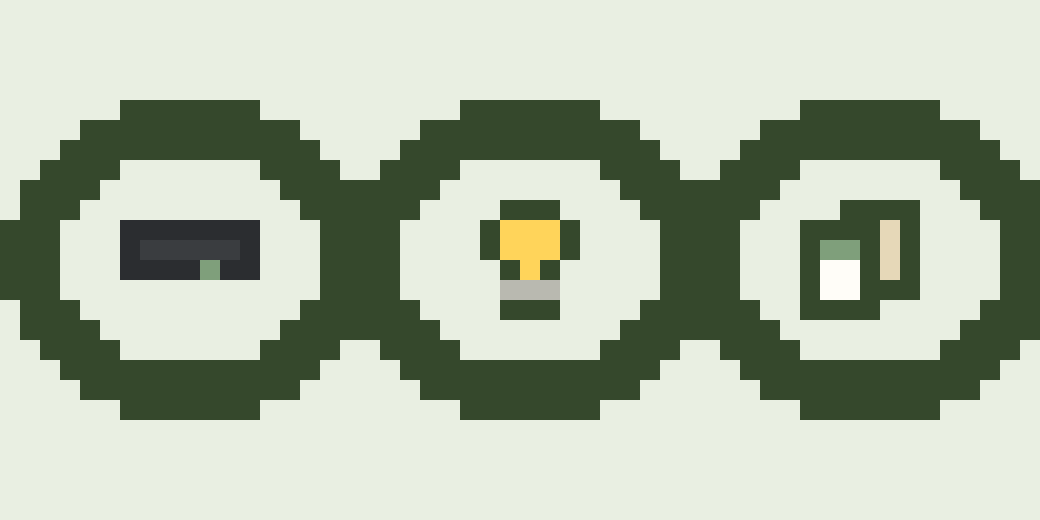
You will have understood: you can give every employee a Copilot licence, provide tokens to use Claude or organise several days of training. None of that guarantees AI will still be used 6 months later. For it to find its place in an organisation, we believe 3 conditions must come together.
- Peace of mind, through hardware: sovereignty, data confidentiality and cost control. Being able to use AI without fearing for your business information or having to watch your consumption.
- Trust, through intelligence: frontier-level capabilities, adapted to professional needs and continuously improved by our lab. An intelligence employees use because it proves its relevance, not because it is presented as revolutionary.
- Accessibility, through use cases: letting everyone discover what AI can do in their job, without having to understand the technical mechanisms that make it work.
These dimensions cannot be separated.
A sovereign intelligence that nobody uses transforms nothing. An accessible but underperforming intelligence ends up losing its users’ trust. And a high-performing intelligence that is too expensive or too complex to deploy stays reserved for a privileged few.
That is the circle we want to break.
Hardware + Intelligence + Use cases = AI adoption.
So our ambition at Appliance Labs is not to put artificial intelligence in a box. It is to let a 10-person business, a 100-employee SME, a mid-sized company or a public administration benefit from an intelligence that is private, high-performing and useful. Without having to build its own research lab. Without having to follow every new model release. Without having to turn its employees into AI engineers. And without having to choose between sovereignty, performance and simplicity.