Dossier · November 4, 2026
AI sovereignty: 4 cases that reveal its limits
Switching off model training and hosting your data in Europe is not enough to guarantee its sovereignty.

· CEO & Founder · 9 min read

Today, many artificial intelligence and cloud providers put forward three arguments to reassure their customers: their data is hosted in Europe, their conversations are not used to train the models, and their exchanges are protected by contractual commitments.
These guarantees matter. But they are sometimes more of a legal and contractual firewall than an absolute technical guarantee.
Because one question remains: who can actually access a company’s data, and under what circumstances?
Four recent cases, involving OpenAI, OVHcloud, Microsoft, Meta and the French Parliament, illustrate different dimensions of this issue.
1. OpenAI: switching off training does not make your conversations inaccessible
October 2026 — United States
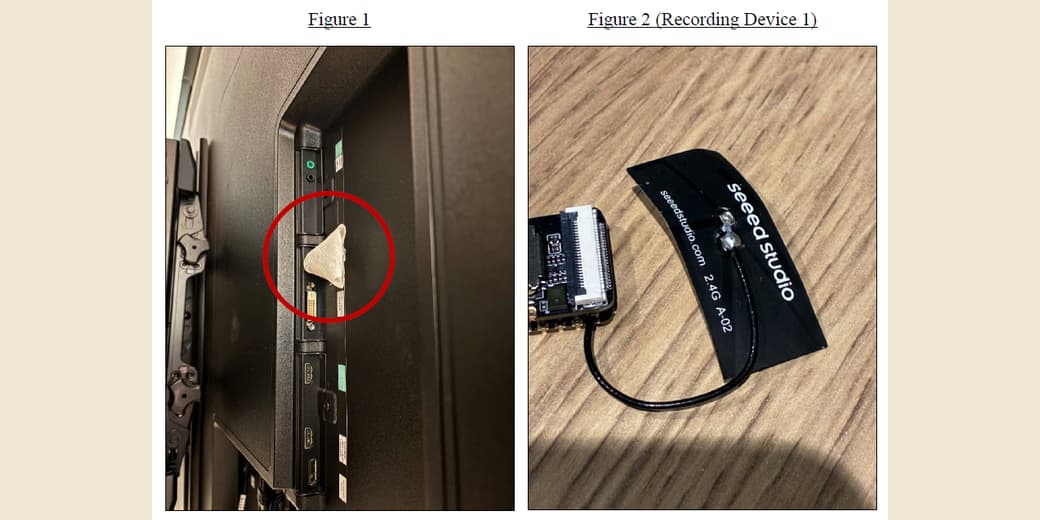
On 9 October 2026, Abdulrahman Alfozan, an engineer at OpenAI since July 2025, is arrested by the FBI. The 35-year-old is suspected of having installed a covert recording device in a meeting room reserved for the company’s executives, in San Francisco.
According to the US Department of Justice press release, the device, discovered on 30 September, was hidden behind a television and connected to a USB port. The room regularly hosted confidential discussions about OpenAI’s research, commercial projects and strategic direction.
The investigation reveals a particularly interesting detail: before the events, Alfozan allegedly used an internal tool to look up information about the buildings, meeting rooms and movements of OpenAI’s executives.
He also allegedly used his wife’s ChatGPT account to carry out technical searches on the design, concealment and operation of an audio recorder.
These queries, made between 24 and 30 September, are among the elements detailed in the criminal complaint made public by the US courts. Fortune confirmed with OpenAI that it was indeed ChatGPT, and not another chatbot.
OpenAI also said it had used its own artificial intelligence models to analyse the device it found, as reported by TechCrunch.
This case highlights a fundamental distinction: switching off the use of your conversations to train the models does not mean that these conversations are not retained, analysed or liable to be disclosed within a legal framework.
This distinction is in fact explicitly set out in OpenAI’s European privacy policy, updated on 24 August 2026. It notably provides for the processing of submitted content to prevent abuse, investigate violations of the terms of use or meet legal obligations.
On 21 October 2026, in the context of the launch of the GPT-6 family and Astra, OpenAI also announced a strengthening and harmonisation of its safety policies, mentioning the monitoring of suspicious uses and the investigations carried out after models are deployed.
This announcement is not a new general authorisation to consult users’ histories: the oversight capabilities it mentions were already in the previous privacy policies.
For companies, then, the question goes well beyond training. When an employee entrusts documents, financial information or strategic exchanges to a remote assistant, that information enters an environment whose access, retention periods and legal obligations are no longer controlled exclusively by their company.
2. OVHcloud: hosting data in France does not place it beyond the reach of foreign jurisdictions
July 2026 — France / Canada

On 31 July 2026, OVHcloud makes public a dispute with the Canadian authorities over a data production order.
Issued in April 2024, this order requires the disclosure of information about subscribers and accounts associated with the IP addresses of servers hosted outside Canada.
Although the infrastructure is located outside Canadian territory, the authorities are seeking to obtain this information from the group, notably through its Canadian subsidiary.
OVHcloud firmly contests this request. In its official press release of 31 July 2026, the company defends the legal independence of its subsidiaries and argues that requests for access to data located abroad must go through international mechanisms for judicial cooperation.
The paradox is significant: a European provider that defends the sovereignty of its infrastructure must itself resist a foreign judicial request targeting data hosted outside the requesting country.
The case does not show that the requested information was actually disclosed. It is a reminder, however, that the physical location of servers is not enough to make conflicts of jurisdiction disappear.
French hosting can therefore offer significant guarantees without being, on its own, an absolute protection against requests from foreign authorities.
Data sovereignty also depends on the legal framework, on how the provider is organised and on the obligations it may be subject to in the various countries where it operates.
3. Microsoft and Meta: data about Dutch civil servants passed to the US Congress
May–September 2026 — Netherlands / United States

In May 2026, the Dutch public broadcaster NOS reveals that Microsoft and Meta passed to US congressional authorities information identifying Dutch civil servants involved in regulating digital platforms.
These disclosures take place against a background of tension between the United States and the European Union over the regulation of the big technology platforms.
The case draws an official response from the Dutch government.
In a letter to Parliament on 29 September 2026, the authorities confirm that they raised the matter with the US ambassador.
The Dutch regulator, the ACM, also protested to Microsoft, notably because the civil servants concerned had not been informed of this disclosure beforehand.
The case illustrates a sometimes underestimated reality: international technology providers operate within legal and political systems that can lead them to disclose information about European actors to foreign institutions.
This is not proof of generalised access to the data of Microsoft Azure customers or to Copilot conversations. But the episode raises a broader question about the obligations that international providers are subject to.
A legal study commissioned by the Dutch government, published in February 2026, sheds further light on this.
Analysing Microsoft’s transparency reports, it counts 26 disclosures of business customer content stored outside the United States, made in response to US warrants between January 2018 and December 2024.
The study states that these figures do not make it possible to determine whether the companies concerned were European, and considers that the overall risk of disclosure in this context remains low.
These elements nonetheless illustrate a fundamental distinction: the location of an infrastructure and the jurisdiction of the provider that operates it are two different questions.
4. France: a per-gigabyte tax that could cost OVHcloud up to €70 million a year
October–November 2026 — France

On 30 October 2026, the Assemblée nationale adopts, by 11 votes to 10, an amendment to the 2027 finance bill introducing a tax of €0.055 per gigabyte of data transmitted to French users.
The stated aim is to make the big international digital platforms contribute more to funding French public services. But what looks, at first sight, like a marginal tax could have considerable consequences for the economics of the cloud and for French companies.
The day after the vote, Octave Klaba, founder of OVHcloud, publishes a costed analysis of the amendment. His estimates reveal the gap between the tax intention and its potential consequences for infrastructure providers.
For OVHcloud, the tax could amount to €70 million a year before the cap.
The calculation is based on the traffic reported by the company: about 500 Gbit/s at the 95th percentile to French internet service providers, or 324 Gbit/s on average.
Over a full year, this volume represents approximately 1.28 billion gigabytes transferred. At the proposed rate, the gross tax would therefore reach €70 million.
The amendment provides for a cap at 15% of revenue generated in France or 2% of worldwide revenue. Depending on the interpretation and the assumptions made by Octave Klaba, the effective annual charge for OVHcloud could thus lie between €23 million and €70 million.
The executive says this charge would have to be passed on to the company’s customers.
And that is precisely where the problem lies: a tax designed to target the American giants could also make digital services more expensive for French companies.
A tax that could almost double the price of cloud transfers
In his analysis, Octave Klaba also compares the tax with the public outbound traffic rates charged by the major cloud providers, notably AWS, Microsoft Azure and Google Cloud.
Depending on the volumes considered, these rates lie between €0.045 and €0.08 per gigabyte.
With an additional tax of €0.055 per gigabyte, the charge would represent 69% to 122% of the current outbound traffic rate, before any effect of the cap.
In other words, if this charge were passed on in full, the cost of some transfers could practically double.
For a company that retrieves archives, migrates data or uses remote infrastructure every day, the amounts quickly take on another dimension.
As a simulation, applying the planned rate to transfers that fall within the scope of the tax:
| Data transferred | Theoretical tax |
|---|---|
| 1 TB | €55 |
| 10 TB | €550 |
| 100 TB | €5,500 |
| 1 PB | €55,000 |
These amounts correspond to a charge calculated at the amendment’s gross rate, not to a new tax directly owed by every company that downloads its own files. They take no account of caps, possible exemptions or how costs are recharged.
The economic impact would therefore depend on the provider, the type of traffic, the contracts and the way costs were shared out.
For companies that handle several terabytes of data every day, or that run applications generating heavy traffic, this uncertainty could become an additional component of the cost of their infrastructure.
A paradox for French digital sovereignty
The question goes beyond the amount of the tax alone.
In 2024, the SREN law had notably sought to reduce the economic and technical barriers to moving data between cloud providers.
Two years later, this new tax proposal could make some of those very flows more expensive.
Octave Klaba also points out the risk of distorted competition between providers with a large presence in France and international players from whom collecting the tax would be harder in practice. Yet the text expressly provides for taxing companies with no French establishment: so it is indeed its effective application, and not its theoretical legal scope, that raises the question.
The potential consequences were analysed by Clubic on 31 October 2026, which notably picked up the orders of magnitude of the simulations published by the founder of OVHcloud.
Of course, this tax has not yet come into force. The government opposed it, and the adoption of an amendment at first reading does not guarantee that it will stay in the final budget text.
But the debate illustrates a fourth dimension of digital sovereignty: even when data remains under a company’s control, its circulation and use can depend on economic rules that are liable to change.
It is an additional dependency, on top of the questions of confidentiality, location and jurisdiction raised by the three previous cases.
Conclusion: sovereignty cannot be decreed. At Appliance Labs, we hold a simple conviction: the most concrete form of sovereignty is still the one you can put on your desk. A box that works for you, at your place, with your data.